

 Media365
In Alta Floresta, a small Amazon town in northern Mato Grosso, eight rope bridges installed in 2024 now span the road leading into town, and the results after 15 months are striking. Camera traps recorded about 15,000 safe crossings by tree-dwelling animals, including several monkey species, and not a single roadkill. The bridges come from Projeto Reconecta, founded by biologist Fernanda Abra, and are now being expanded in other parts of Brazil and in Suriname. Brazil’s National Department of Transport Infrastructure has also named the design its recommended highway standard, which could bring similar crossings to roads across the country.
Why roads are deadly for Brazilian wildlife and the domino effect on Amazon forests
Brazil has the greatest diversity of primates in the world and also the fourth-largest road network, a dangerous combination for animals living along forest edges split apart by highways. A 2022 study ‘How Many Mammals Are Killed on Brazilian Roads? Assessing Impacts and Conservation Implications’ found that nearly 9 million mammals are killed on Brazil’s roads every year.The harm goes beyond collisions. Animals that come down from the trees to cross a road can be hit by vehicles, while strictly tree-dwelling species avoid the ground altogether and end up isolated by the road as a barrier. Isolated populations grow smaller and more vulnerable, and without gene flow between groups, a species loses genetic diversity.As per Mongabay, primatologist Fabiano Rodrigues de Melo describes a domino effect, losing fruit-eating primates can change the makeup of a forest, because they help disperse seeds and even contribute to pollination.
Which monkeys and other animals use the aerial crossings
Abra wanted a solution that was simple, low in cost and durable. The current bridge has a multilayer design that suits animals that move in different ways, including species that rely on prehensile tails, arm-swinging species such as spider monkeys, and species that simply walk across a network of crossed ropes.Every bridge carries two camera traps, one facing the crossing to record which animals use it, and one facing the forest to see which animals arrive but decide not to cross. Primates recorded in the first months included the black-faced black spider monkey, the Purus red howler monkey, the northern night monkey, the tufted capuchin, Schneider’s marmoset and the Alta Floresta titi monkey. Opossums, sloths and mouse opossums have also been seen using the bridges.The titi monkey has special meaning for the project. It was described only in 2019, was soon classified as critically endangered, and has become the symbol of the initiative.
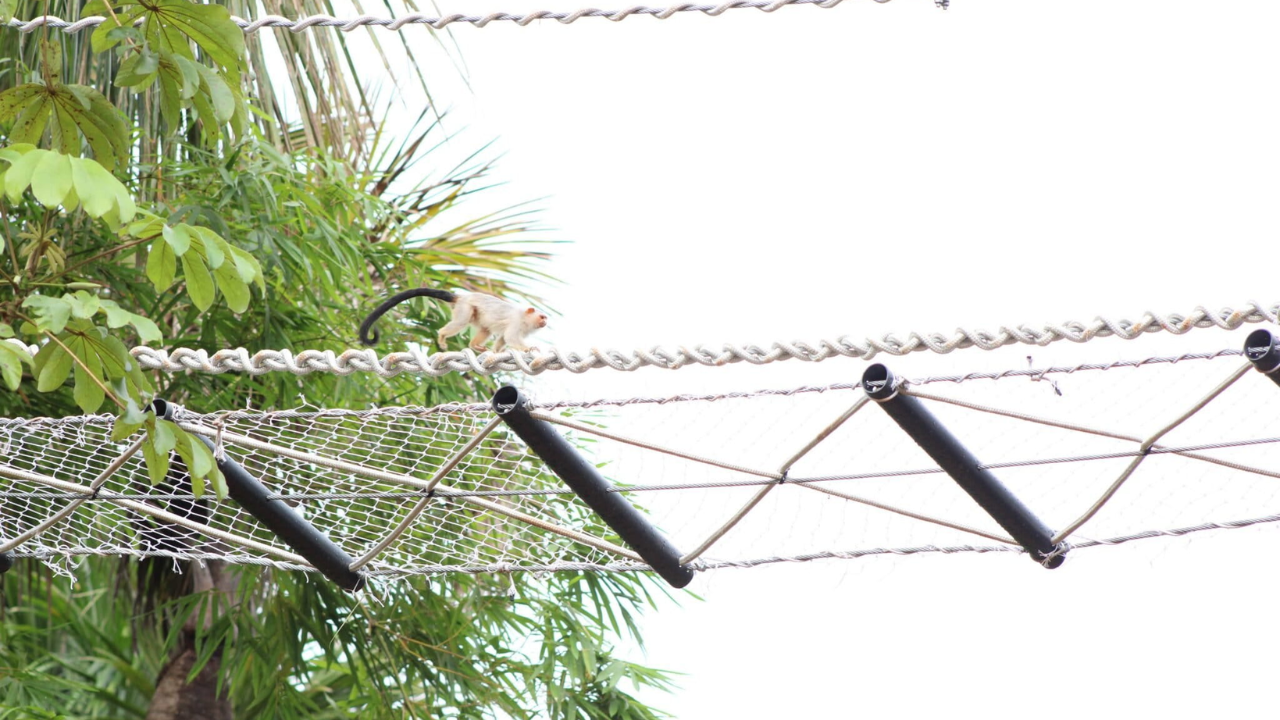
The current bridge has a multilayer design that suits animals that move in different ways (Image: Maelle Lima de Freitas)
15,000 camera trap crossings, zero roadkill and the slow pace of animal adaptation
The eight bridges were installed in 2024, and over 15 months the camera trap footage showed 15,000 safe crossings by tree-dwelling animals and no roadkill. The project involves the municipal government along with local organisations and business owners.The animals did not all adapt at the same speed. Tufted capuchins took seven months before using one of the bridges for the first time, which may suggest that each species has its own pace. Abra says this is why patience matters. She notes that conservation urgency often ignores the time an impact takes to unfold.
Lessons from Highway 174 and the Waimiri-Atroari Indigenous territory, where Reconecta began
Alta Floresta is not the project’s first site. In 2021, working with the Waimiri-Atroari Indigenous people, the team installed 32 canopy bridges over Highway 174, which crosses their territory and the Amazon between the states of Amazonas and Roraima. The project’s own website gives a figure of 30 bridges on that road, so the count appears to have changed over time. The website credits the Smithsonian Institution, the Waimiri-Atroari people, the Federal University of Amazonas and the National Department of Transport Infrastructure as partners, and describes combining modern technology with traditional Indigenous knowledge.Over five years, cameras on the bridge poles have documented about 1,250 primate crossings there, including the golden-handed tamarin, which often descends to the ground and is therefore especially vulnerable to roadkill. That highway was built in the 1970s, and monitoring shows that animals use the structures more as time passes.
National standards for wildlife crossings and expansion to other locations
Abra said eight more bridges would be installed in Alta Floresta’s urban area in August, after the electric utility lowers and insulates power lines so animals jumping from a bridge onto the wires are not electrocuted. New chapters are planned in Suriname and in Lucas do Rio Verde, which will install 10 canopy bridges.The wider policy picture is also shifting. In 2026, Brazil’s National Department of Transport Infrastructure designated the rope bridge design as the recommended standard for highways. A bill to create a National Road Safety Plan for Wildlife has passed the Chamber of Deputies and awaits a vote in the Senate.Abra also hopes to reach other habitats. She points to the highway through the Pantanal known as the “highway of death,” where roughly 2,000 animals are killed each year, and to the Atlantic Forest, home to threatened monkeys such as muriquis and howler monkeys.


