

 Media365
Two years ago, Mundakkai and Churalmala in Kerala experienced powerful landslides that killed hundreds of people. Last year, a large village in Dharali, Uttarakhand, was washed away following heavy rains. In the monsoon season of 2025, the States in Northeast India were devastated by frequent floods. More than a hundred people lost their lives after heavy rains in Uttar Pradesh on May 13-14 this year.
During such disasters, it is common for telecom towers to topple over, power lines to be cut, and roads to be closed. In these situations, real-time information as to what is happening on the ground, where people are stuck, which routes are still open, etc. become crucial for rescue workers and medical workers. In the absence of such communication, rescue operations are delayed, more property is damaged, and more lives are lost.

Cooperative caching
‘Solving’ communications in disaster-affected areas is a long-standing problem. Recently, in a paper published in the IEEE Transactions on Services Computing, researchers from Ireland, led by Sangita Dhara of Trinity College Dublin, presented a novel approach — a way to transmit important real-time information using a technology called collaborative caching even if the local network is in a subpar condition.
At a time of disaster, the local administration typically has three main communication channels: satellite or satellite-based communications, drones or unmanned aerial vehicles, and some ad hoc network based on the ground. A satellite can beam data down over a wide area, so accessing that signal is relatively easy, but the big problem here is data latency, i.e. the delay in getting information. Time is of the essence. It is also possible to take pictures from the sky or transmit live video using drones. However, they are limited by their short range, limited battery capacity, and, above all, obstacles in the form of inclement weather. Finally, ground-based wireless networks can help with local communication — but they are often damaged or non-functional during disasters.
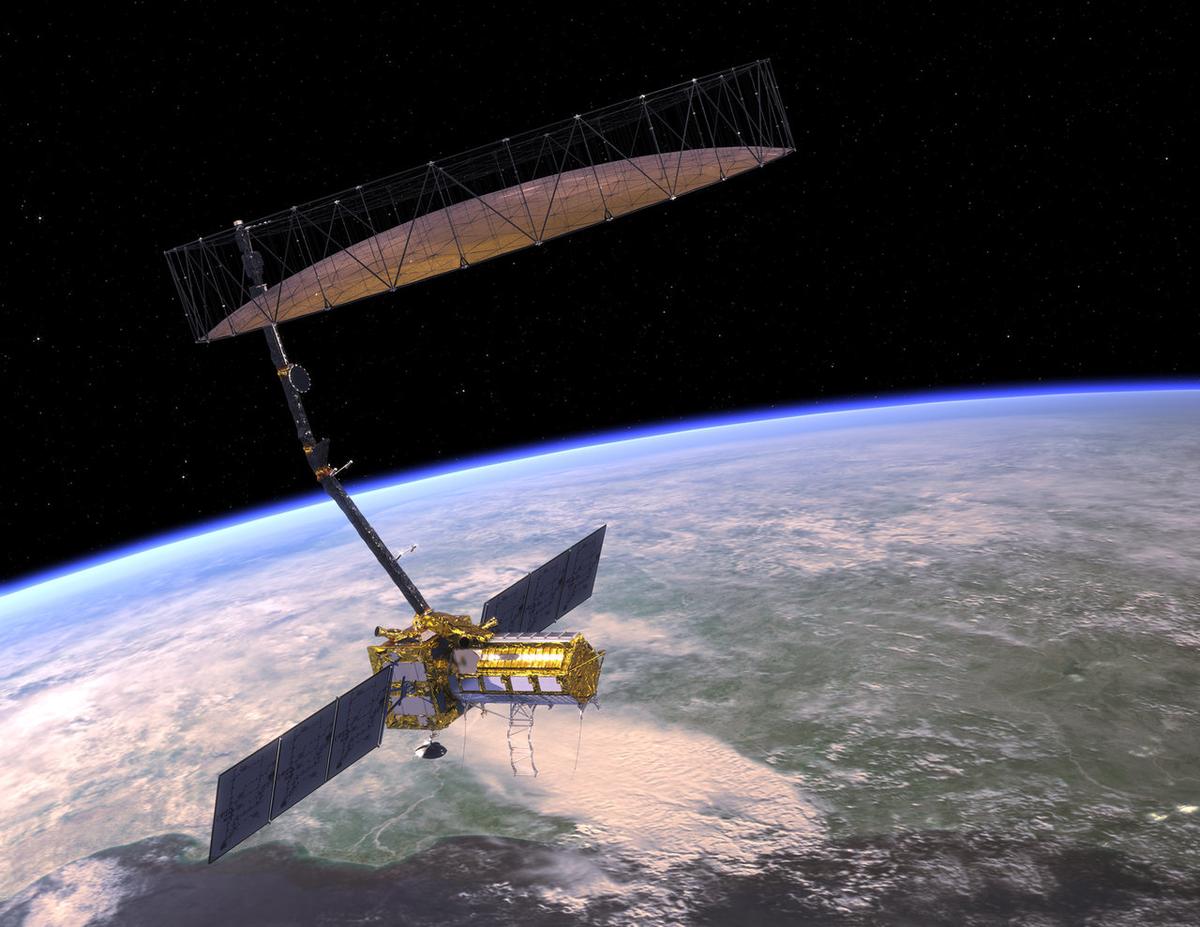
During a disaster, the NASA-ISRO SAR, or NISAR, satellite can deliver damage proxy maps in under five hours.The NISAR satellite
| Photo Credit:
NASA
In this context, the researchers have presented cooperative caching. Here, different parts of a disaster-response network, including satellites, drones, base stations, and emergency vehicles, work together to store and share useful data. When one node receives or generates important content, such as satellite images or video, nearby nodes may also cache copies based on the demand. This cooperation allows rescue teams to retrieve information from the nearest available source rather than a distant origin, reducing delay, improving reliability when infrastructure is damaged, and increasing the chance that critical information is available in real time.
Automatic decision-making
Creating this caching system is technologically not simple, however. The drones are airborne, rescue vehicles are on the road, and the position of satellites is constantly changing. It is also difficult to know when and where information will be required, plus the storage of each device will be limited.
To address this problem, the researchers developed a statistical model called contextual multi-armed bandit (CMAB), an artificial intelligence (AI) model that optimises caching decisions on-the-fly. The model learns from each of the previous decisions, then reviews three factors: what data are recently available, what data demand is currently high, and how much memory is needed in the cache.
For example, it would be helpful to understand that a photo taken 10 minutes before a flood is more effective than a photo taken 1 hour before the flood. Similarly, video footage or a map of a place that most rescuers are asking for is more important than those that fewer ones are looking for. Sometimes, instead of caching high-resolution video — such as 4K video — short text alerts or warning messages could help rescuers remain productive without taking up large amounts of storage. The model is taught to make such decisions automatically.

Federated learning
While in CMAB each node learns from what information it alone has, a more advanced version called FMAB — short for federated multi-armed bandit — learns from its information as well as what the nodes nearby have learnt.
“Caching decisions are executed periodically rather than per request, amortising the computational cost,” the researchers wrote in their paper. “Even the highest observed decision latency of Contextual MAB [around 87 microseconds] remains negligible compared to network delays, ensuring system complexity does not hinder the practical applicability for dynamic and real-time, post-disaster deployments.”
The work also highlights the importance of a three-tier network, where space, air, and ground are working together, called Space Air Ground Integrated Network (SAGIN). Here, each layer plays a unique role, but the limitations that exist between them are greatly reduced due to caching, and the system becomes more efficient. In the post-disaster scenario, it is important not to look at all the information that is available but only at which information is more useful. An updated road map can tell us which bridges are still usable while a live video can let us know that boats are urgently needed in a specific part of the floodplain.

Weather drones are uncrewed aerial vehicles that bears sensors to collect weather data from the lower and middle atmosphere. Representative illustration.
| Photo Credit:
Image created with AI
All together
As a result, content should be seen not only as data but as time-dependent actionable data. And the goal of advanced caching should be to learn how to store the most valuable information in the most appropriate place with limited resources.
To meet this goal, SAGIN works to build external infrastructure, CMAB helps to make acceptable decisions, and FMAB can make the network stronger in the post-disaster period by spreading those decisions across multiple nodes. However, the results of this simulation-based study depend on many parameters, such as the weather at the time, the flight of the drone, energy management, hardware malfunctions, cyber security, and the behaviour of rescuers in reality.
Moreover, it is not always technically possible to determine which content is valuable or preferable. In many cases, the needs of the local administration or humanitarian considerations can also speed up the rescue.
Shamim Haque Mondal is with the Physics Division, State Forensic Science Laboratory, Kolkata.

Published – June 29, 2026 07:30 am IST
