

 Media365
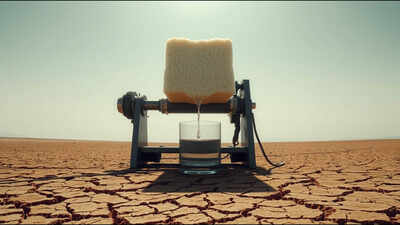
Researchers at Kiel University in Germany have developed a highly porous material that can pull drinking water directly out of dry air, offering a possible lifeline for regions where rainfall is becoming less reliable. The material, known as CAU-10-H, behaves like a sponge, absorbing water vapour from the atmosphere and releasing it again as liquid water. Under dry conditions, one kilogram of the composite can produce up to 1.8 litres of clean drinking water every day. Scientists say the technology is especially suited to hot, dry regions around the Mediterranean, where rising temperatures and falling rainfall are already straining freshwater supplies, and the same material could also make cooling systems significantly more energy efficient.
How the sponge-like material pulls water from dry air
CAU-10-H belongs to a class of compounds called metal organic frameworks, or MOFs, which are built from an extremely porous internal structure filled with countless microscopic, interconnected cavities. According to an official statement from Kiel University, the material captures water molecules at room temperature once relative humidity reaches just 18 per cent, a level most existing systems would consider too dry to work with. Once heated to around 70 degrees Celsius, it releases the trapped water again, allowing the cycle to repeat. This ability to function in near desert-level dryness is what sets CAU-10-H apart from older moisture harvesting materials, which typically need much wetter air to operate effectively.
Why the material can be produced at a larger scale now
The Kiel team, led by Professor Norbert Stock at the university’s Institute of Inorganic Chemistry, combined CAU-10-H with electrically conductive carbon structures to speed up how quickly the material releases its stored water. This composite can be heated efficiently using either electricity or sunlight, allowing it to complete a full capture and release cycle within just a few hours rather than a full day. That speed matters because a material that resets faster can produce more water over the course of a day, even without changing how much moisture it captures in a single cycle. The findings were published across two papers, one in the journal Journal of Materials Chemistry A titled Electrically conductive MOF@ carbon foam composites for atmospheric water harvesting through internal Joule heating and light irradiation, describing the technical mechanism behind the faster cycling.
What the tests actually showed about water output
Laboratory tests found the composite material can absorb up to 0.17 grams of water for every gram of material under dry conditions, a figure that translates into the 1.8 litre daily output researchers have highlighted. Kiel University’s own account of the work states that under dry conditions, the system continuously produces drinking water from the air using this uptake rate. Professor Stock said the team’s goal is to develop an environmentally friendly technology that converts water molecules from the air into drinking water, particularly for regions like the Mediterranean that are facing rising temperatures and declining rainfall. Lasse Wegner, the lead author of the water harvesting study, said the material’s ability to work even in arid air is what makes it particularly attractive for producing drinking water in dry regions.
How the same material could also improve cooling systems
Beyond drinking water, researchers found that CAU-10-H has a second practical use as a refrigerant inside adsorption-based cooling systems, which rely on repeated water vapour cycles to produce a cooling effect. In tests, the material delivered up to three times the cooling performance of silica gel, the moisture-absorbing material that has been the industry standard in many air conditioning systems for decades. A second study, published in the journal Industrial and Engineering Chemistry Research and led by Kalle Mertin, examined how the material performs once produced at a larger, pilot scale, alongside a techno-economic analysis of running it inside a full-scale cooling system. Because CAU-10-H can be regenerated using low-grade heat, researchers say future cooling systems built around the material could run on waste heat from sources like data centres, factories or bakeries instead of relying so heavily on electricity.
Why this technology could matter for water-stressed regions
CAU-10-H was actually first discovered at Kiel University around 15 years ago, and Stock has been studying its properties for more than two decades, but this latest work marks the first time the material has been produced successfully at a pilot scale rather than only in small laboratory batches. That shift matters because a material has to be manufactured in much larger quantities before it can move toward real-world deployment. The broader scientific field behind these materials received global recognition when the foundational chemistry of metal organic frameworks earned the 2025 Nobel Prize in Chemistry, underlining how significant this class of porous materials has become for addressing water scarcity. With freshwater supplies already under pressure across large parts of the Mediterranean and other arid regions, a material that can reliably pull water from air as dry as 18 per cent humidity could offer a genuinely new route to producing drinking water where conventional sources are running short.


