

 Media365
A single page from one of the most important books in printing history spent decades sitting unnoticed in an English attic. Bought for just £25 in the early 20th century, the roughly 570-year-old leaf from the Gutenberg Bible was rediscovered among a grandfather’s belongings and eventually sold at auction for £39,000 in 2025.The rare page was found by a resident of Bromsgrove, Worcestershire, among possessions belonging to his late grandfather. The items had been stored in a box in the family attic that had remained unopened for more than 50 years. The family reportedly believed the Bible leaf had originally belonged to the man’s great-grandfather, an early 20th-century traveller and collector who visited Europe and the Far East and was known to frequent auction rooms.The family had first seen the collection around 2000, after the man’s grandmother died, but it was only in 2024 that they decided to have the items examined and authenticated. When the box eventually reached Chorley’s Auctioneers, the significance of one particular sheet became clear.What appeared to be an old page was in fact a leaf from the Gutenberg Bible, printed in Mainz, Germany, around 1455 by Johannes Gutenberg and Johann Fust.
From £25 purchase to £39,000 auction sale
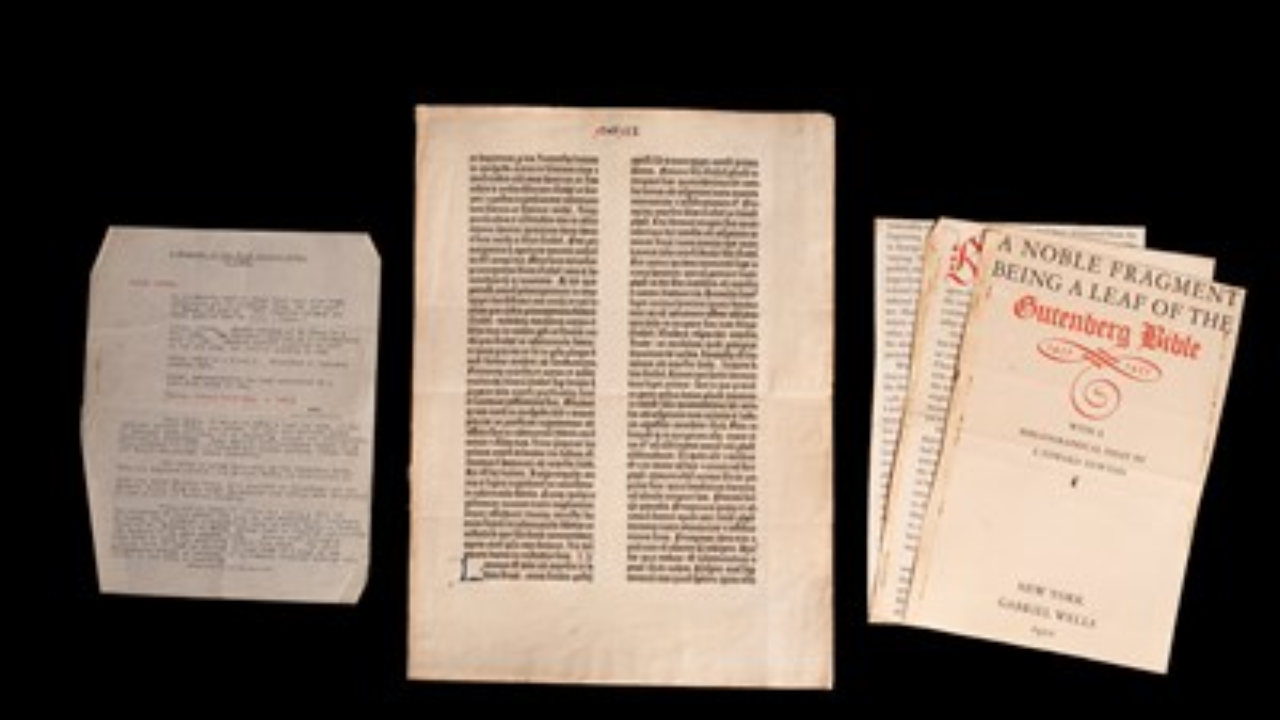
The leaf measures approximately 39.2 by 28.6 centimetres and contains 42 lines of text arranged in two columns.
The page was offered as Lot 401 at Chorley’s March 2025 auction in the Cotswolds. Before the sale, it carried an estimate of £20,000 to £30,000. It ultimately exceeded that estimate, selling for £39,000 at the March 25 auction. Antiques Trade Gazette reported that the £39,000 figure was the hammer price, before the buyer’s premium.The original £25 purchase is part of the object’s remarkable story. The surviving documentation indicates that the leaf may have been among the individual Gutenberg Bible leaves sold by American antiquarian bookseller Gabriel Wells in the 1920s.Chorley’s catalogue notes that the leaf came with loose pages from A. Edward Newton’s 1921 essay ‘A Noble Fragment’, which accompanied Gutenberg Bible leaves distributed by Wells. The auction house cautioned that this material does not conclusively prove the leaf was one of Wells’ original sales, but said it lends credibility to that possible provenance.Wells had acquired an incomplete Gutenberg Bible and made the controversial decision to dismantle it, selling individual leaves to collectors. According to Chorley’s, leaves in good condition were selling for an average of about $150 at the time, while damaged examples were priced around $100.What was once considered an acceptable way of distributing pieces of a damaged historic book is viewed very differently today.
What is on the 570-year-old page?
The leaf measures approximately 39.2 by 28.6 centimetres and contains 42 lines of text arranged in two columns. It comes from the Book of Numbers, covering parts of verses 8:13 through 10:23. The passages include the setting apart of the Levites, the Passover and the account of the cloud above the Tabernacle.Despite being more than five centuries old, the page retains striking details. The text is printed in Gothic type, while the initials were added in red and blue. The chapter heading letters also alternate between the two colours.The auction house described the leaf as an incunabulum, a term used for books printed in Europe during the earliest period of printing with movable type, generally before 1501.The page was not flawless. Its condition report noted toning and foxing, a central fold with some wear, marginal browning and chipping, and slight loss to one upper corner. There was also some staining from the page-edge colouring and evidence of an inked number on the inner margin. Yet its historical importance far outweighed those imperfections.
The book that changed printing
Only 49 complete copies or substantial portions are currently known to have survived
The Gutenberg Bible is widely regarded as the first substantial book printed with movable type in the Western world. Its production in Mainz in the mid-15th century by Johannes Gutenberg marked a major turning point in the history of European printing.Before the spread of movable-type printing, books had to be copied by hand, a painstaking process that made them expensive and limited their availability. Gutenberg’s printing methods allowed multiple copies of a large book to be produced with far greater efficiency.The Gutenberg Bible was printed in an edition of roughly 180 copies on paper and vellum. Chorley’s says the original edition contained more than 640 leaves and would have taken several years and a team of workers to produce.Only 49 complete copies or substantial portions are currently known to have survived, according to the auction house. No complete Gutenberg Bible has been sold at auction since 1978, making individual leaves an important way for collectors and institutions to acquire a physical fragment of the historic work.


