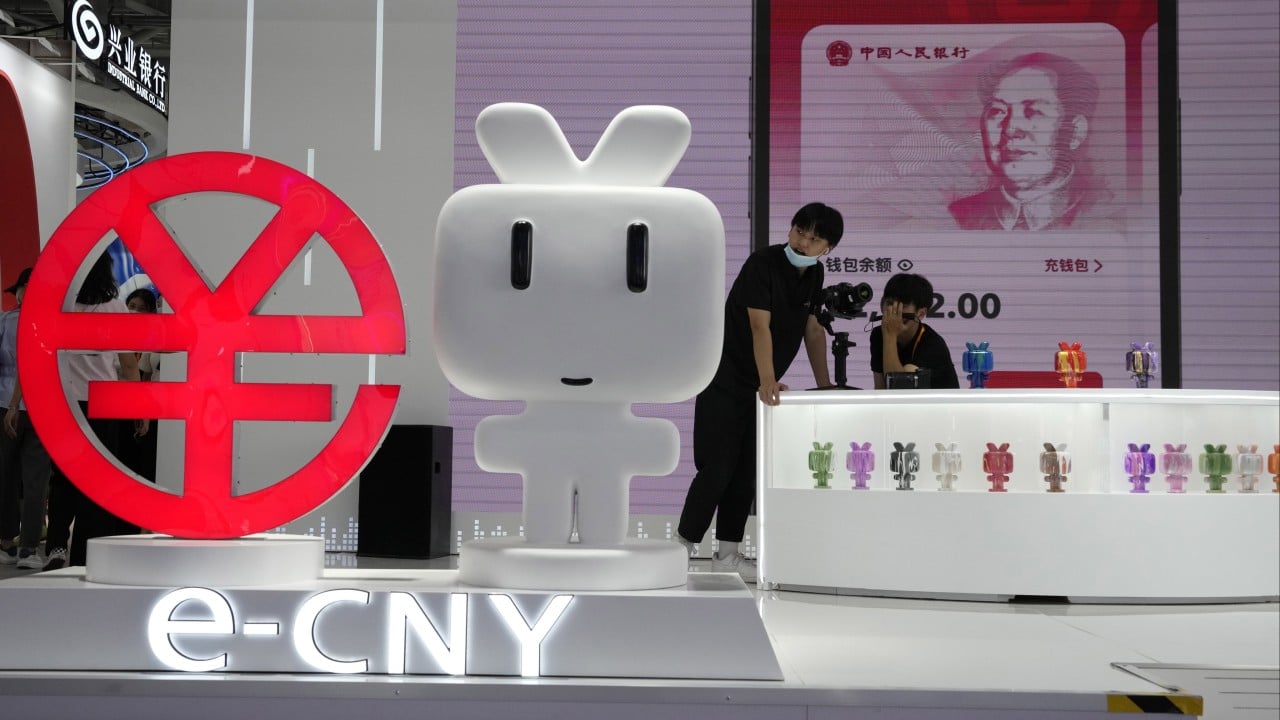
More than a month after China’s central bank upgraded the digital yuan from a cash equivalent to “digital deposit money” – allowing it to accrue interest like a bank deposit – many residents and merchants in Beijing have yet to notice a major difference.
While signs accepting digital yuan – also known as e-CNY – have long been commonplace in department stores and supermarkets, multiple sales staff said the dedicated point-of-sale machines had sat idle for months, if not years. At most wet markets and street stalls, the familiar green and blue WeChat Pay and Alipay QR codes continued to dominate.
The slow uptake underscores that China still has a long way to go to realise its ambitions. Despite government and public sector incentives, such as issuing consumption coupons and tax rebates through the system, users have shown little motivation to embrace the digital currency.
Chloe Cui, an employee at a state-owned bank, is paid a portion of her salary in digital yuan – another initiative to expand domestic use. But every month, she transfers the money straight to her regular bank account. “I’ve never used [it] for payments. I only use it when receiving money,” she said.
The ruling Communist Party had pledged to “steadily develop the digital yuan” in its proposal for the new five-year plan, the country’s top socio-economic development blueprint. The new framework, which took effect on January 1, was part of that drive. Pitched as a shift from “digital cash” to deeper integration with the regulated financial system, it lowered the reserve requirement ratio for commercial banks holding digital yuan, while adding an interest-bearing feature similar to traditional bank deposits.
The upgraded digital yuan would also incorporate more emerging technologies than the traditional monetary system, boosting digitisation across issuance, circulation and payment – a move analysts see as Beijing’s answer to stablecoins.


 Media365