How Chinese robotaxi giants are steering the Middle East towards a driverless future


When hailing a car on Uber, riders usually choose between economy and premium options. But in certain areas in Abu Dhabi, capital of the United Arab Emirates, the first choice that flashes on the screen is “autonomous”.

The availability of driverless cars underscores the urgency of the nation’s push to promote clean energy and reduce dependence on oil and gas. At the forefront of this effort are Chinese robotaxi developers, which see the Middle East as one of their starting points for global expansion.

Recent developments include WeRide and Baidu’s Apollo Go securing fully driverless permits in Abu Dhabi, Pony.ai starting pilot testing in Dubai, and CaoCao – a ride-hailing service backed by Chinese carmaker Geely – becoming the fourth Chinese robotaxi operator to enter the UAE.
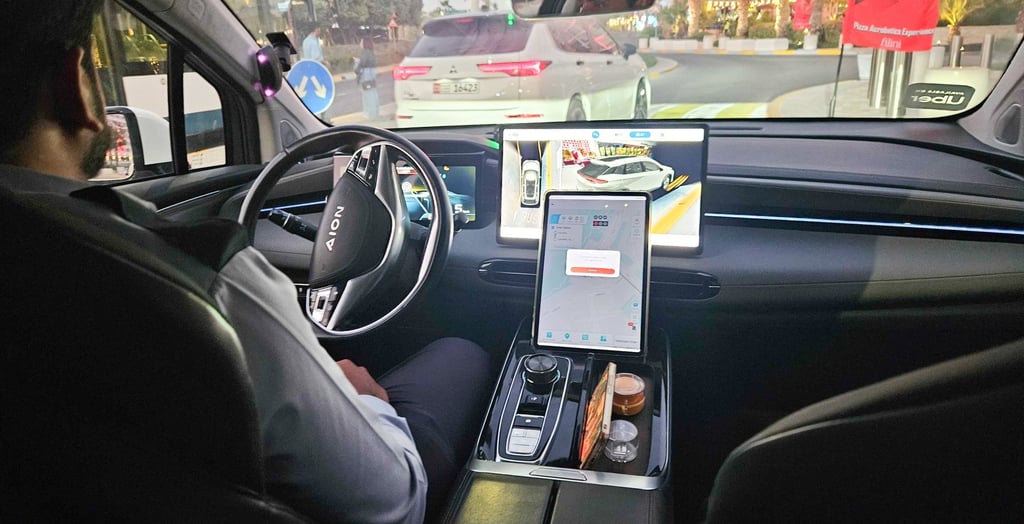
In December, the Post hailed a WeRide self-driving car via Uber on Abu Dhabi’s Yas Island, a recreational zone featuring popular attractions like Ferrari World and Warner Bros. World. Compared with the Post’s ride in the central Chinese city of Wuhan in 2024, the momentum in Abu Dhabi is only beginning to build.
The interior of a WeRide robotaxi with a safety operator. Photo: Coco Feng

On Yas Island, robotaxis were scarcely visible even on one of the busiest days of the year – when the 2025 Abu Dhabi Grand Prix was held. By contrast, a regular workday in Wuhan saw a much larger fleet of self-driving cars, mostly Apollo Go, operating even in the downtown area.

Booking the cars was easy. Riders selected the designated pick-up and drop-off points on Uber and the vehicle arrived within two minutes at the precise location. Once seated, passengers tapped a “Start” button on a tablet mounted on the back of the front seat.

  • Related Posts

    Hong Kong turns the page on paper shares as digital shift kicks off in November

    Hong Kong will roll out a fully digital, paperless stock market from November 16, a move aimed at boosting efficiency and strengthening the city’s competitiveness, the market regulator said on…

    Continue reading
    Exclusive | HKU eyes up to US$385 million bond to fund Northern Metropolis expansion

    The University of Hong Kong (HKU) will begin a roadshow this week to gauge investor interest in a landmark bond programme that could raise up to HK$3 billion (US$385 million)…

    Continue reading

    Leave a Reply

    Your email address will not be published. Required fields are marked *