

 Media365
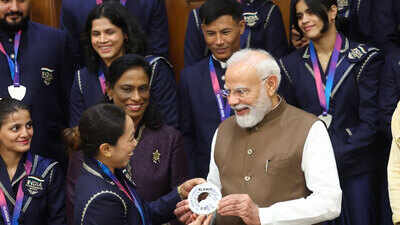
NEW DELHI: “From every drop of tears, gold medals are dripping.”Prime Minister Narendra Modi had an emotional message for Mirabai Chanu as he interacted with India’s Commonwealth Games 2026 medal winners at his residence on Sunday, reflecting on the sacrifices behind the country’s successful campaign in Glasgow.Modi hosted the medal-winning contingent at 7, Lok Kalyan Marg and heard athletes recount some of the moments that defined their journeys at the Games. India returned from Glasgow with 39 medals, including 13 gold, 17 silver and nine bronze, finishing fourth in the overall standings.During one of the conversations, Modi recalled the emotional scenes surrounding Mirabai’s gold-medal triumph.“Tears were falling from you. I feel as if from every drop of tears, gold medals are dripping,” Modi told the Olympic silver medallist.
Mirabai recalls four years of struggle
Mirabai, who won gold in Glasgow, opened up about the difficult journey that preceded her Commonwealth Games triumph, including the disappointment of the Paris Olympics.“I was very happy, and emotional too. That day the happiness was greater and I cried because at the Paris Olympics, I lost a medal by 1 kg. In a player’s life what all we have to face. So within these 4 years, how much and what all I had faced, every time injuries were going on and all that was happening. So with great difficulty I had faced these 4 years. So when all that happened, on the podium when I stood, sir, and when our flag goes up and our national anthem plays, sir, we cannot stop, sir, tears come out on their own,” she said.Modi responded by highlighting the wider impact of the athletes’ achievements.“This is very good. It is not as if this achievement of yours is considered only your achievement; your victory becomes a very big inspiration for the coming generations.”
‘One family will bring three medals’
The informal interaction also saw athletes share lighter and deeply personal moments from their Glasgow campaigns.Modi reminded para shot put gold medallist Sharmila Dhankar of a promise she had made earlier.“You made a promise. Last time, yours, both daughters will become players,” Modi said with a smile.Dhankar replied: “Haanji, right now they are young in age. In the next Commonwealth, one family will bring 3 medals.”Men’s 100m T47 gold medallist Dilip Gavit, meanwhile, spoke about dedicating his performance to his guru.“When I was running, when my event was on 29th (July), that day was Guru Purnima, so that day I gave a gift to my guru,” he was heard saying in the video.In another video posted by Modi, gold medallist boxer Sakshi Chaudhary introduced herself and the contingent.“Hello friends! This is Sakshi Chaudhary. Today, our honourable Prime Minister has invited us, the Commonwealth Games medalists, and we feel very proud. We are extremely happy to have met him; he is very humble. Sir, would you like to say something?” she said.Modi replied with a message that summed up his interaction with the athletes: “Jo khelega, woh khilega” (The one who plays, will blossom). “Always cheer for Bharat.”
India’s Glasgow success
India’s fourth-place finish came despite a significantly smaller contingent and a reduced sporting programme compared to Birmingham 2022. India sent 122 athletes to Glasgow, compared to 210 in Birmingham, while 30 of its 61 medals in 2022 came in sports that were not part of the Glasgow programme.Despite those limitations, India retained its fourth-place position and improved its medal conversion rate, with 38 athletes returning home with medals. Long-distance runner Gulveer Singh was the only Indian athlete to win two medals.The Glasgow Games concluded after 11 days, with Scotland handing over the Commonwealth Games flag and ceremonial baton to India ahead of the 2030 edition in Ahmedabad.The symbols were handed to Olympic champion Neeraj Chopra, Indian Olympic Association president PT Usha and Gujarat Deputy Chief Minister Harsh Sanghavi during the closing ceremony.Ahmedabad will become only the second Indian city to host the Commonwealth Games after New Delhi staged the 2010 edition.


